⚠️ SAFETY FIRST: READ BEFORE STARTING
Working on electric showers is dangerous. You are dealing with a high-voltage appliance (240V) and water.
ISOLATE POWER: Always turn off the electricity at the main consumer unit (fuse box) and pull the isolation cord before removing the shower cover.
VERIFY DEAD: Use a voltage tester to ensure no power is reaching the unit.
LEGALS: In the UK, major electrical work in bathrooms is "Part P" regulated. If you are not a competent person or are unsure of these tests, stop and consult a Part P qualified electrician.
DISCLAIMER: You follow these guides at your own risk. This site and its authors are not liable for any injury, loss, or damage caused by your repairs.
If your electric shower has suddenly stopped heating, the Thermal Cut-Out (TCO) is the first thing you should check. This vital safety switch sits on top of the heating tank and cuts the power if the water gets dangerously hot. In this guide, I’ll show you how to perform a simple continuity test to see if your TCO has blown and—more importantly—what caused it to trip so you don't burn out a replacement.
What is a Thermal Cut-Out (TCO)?
The TCO is a safety switch mounted on top of the heater canister. Its job is to disconnect power to the heating elements if the water temperature exceeds a safe limit (usually around 75°C to 80°C).
There are two types you’ll find in Triton and Mira showers:
One-Shot TCO: Once it "pops," it is dead and must be replaced.
Resettable TCO: Some older models have a small button in the center you can push back down (though if it trips often, it still needs replacing).
How to Test the TCO (The Continuity Test)
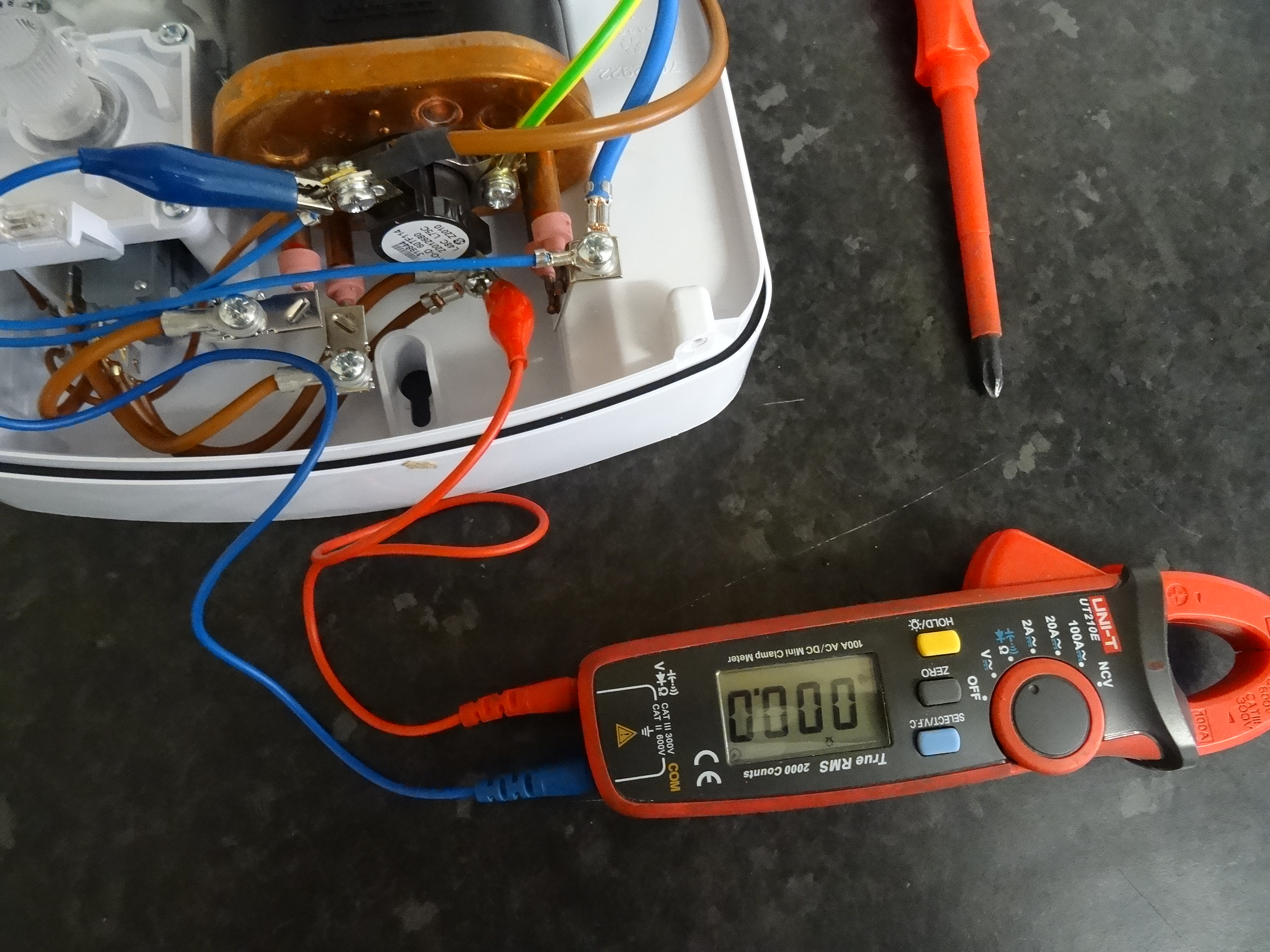
To find out if your TCO is the reason your shower is cold, you need a multimeter.
Step 1: Isolate the power at the fuse box. (Never skip this!)
Step 2: Set your multimeter to the Continuity setting (the one that beeps) or the lowest Ohms ($\Omega$) setting.
Step 3: Place one probe on each of the two terminals on top of the TCO.
The Result: If it BEEPS (or shows 0.00), the TCO is working. If there is SILENCE (or "OL"), the TCO is "Open Circuit" and must be replaced.
Buy electric shower parts on Ebay UK here
Need a Multimeter for testing try on Ebay UK here
What is a TCO and Why Does it Trip?
The TCO is a "one-shot" fuse or a bi-metal switch. If the water flow drops too low while the heat is on high, the temperature spikes and the TCO "pops" to prevent the plastic tank from melting or scalding the user.
Common causes for a tripped TCO:
Limescale: A blocked shower head or scale inside the heater tank.
Reduced Flow: A kinked hose or a partially closed stop-tap.
User Error: Turning the shower off at the pull-cord immediately after a hot shower without letting the "Phased Shutdown" cool the tank first.
The Continuity Test (Step-by-Step)
Isolate Power: ⚠️ DO NOT SKIP. Turn off the power at the consumer unit/fuse box.
Access the TCO: It is usually located on the top of the silver heating cylinder.
Set Multimeter: Turn your dial to Continuity (the 'beep' setting) or the lowest Ohm (Ω) range.
Test: Place one probe on each of the two terminals on the TCO.
BEEP / 0.00 Ohms: The TCO is GOOD. (Your fault is elsewhere, likely the element).
No Beep / 'OL': The TCO is DEAD and must be replaced.
How to Replace it Safely
Replacing the TCO is a simple 5-minute job. Simply pull off the spade connectors, undo the two retaining screws, and swap in the new part. Ensure the wires are pushed on tightly; a loose connection creates heat, which will melt the new TCO.




No comments:
Post a Comment